
October 14, 2026
Community Brought A Lost Dog Home; It’s Also What Keeps Donors Giving
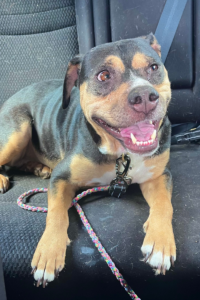
Earlier this month, my newly adopted rescue dog bolted through an open door and vanished into the greenbelt behind our home. Macaroni is a survivor of trauma and multiple surgeries who had only just begun to trust my daughter and me, one quiet gesture at a time. And then he was gone.
 What happened next didn’t teach me something new about community, but it sure reminded me how far its reach really is. Neighbors I had never met walked their dogs around in search and passed out flyers. A stranger named Terra spent her days stopping people on the sidewalk to ask them to watch for him. A local rescue group sent volunteers into the field overnight, moving traps by hand. A drone pilot we hired for one afternoon gave us days, unpaid, just because he wanted to help. None of these people owe us anything—Mac wasn’t their dog. And still, for five days, near-strangers organized themselves around bringing one scared dog home.
At 1 a.m. on the fifth night, my phone rang. “We got him.”
That’s the same instinct we’re trying—mostly on purpose, sometimes accidentally—to build into how nonprofits engage donors. People will show up for something bigger than themselves. The question is whether we’re building anything for them to show up for.
The funding landscape nonprofits are navigating right now rewards a specific kind of donor—the one who keeps showing up. Recurring donors are retained at roughly 78% to 80%, compared to around 32% for one-time givers; and they stay engaged for an average of 7.8 years versus 1.7 for non-recurring supporters. Nonprofits retain their sustaining donors at more than 2.5 times the rate of one-time supporters, year after year. In one five-year study of close to 100,000 donors, those who gave every year contributed far more over time than one-time donors did, and annual givers “made up only 11.7% of the donor pool, yet drove 45% of total revenue.”
This is usually framed as a fundraising mechanism—build a monthly giving program, automate the ask, reduce the friction, etc. But the mechanics aren’t what makes someone stay for seven years instead of one … community is.
Belonging Isn’t Soft; It’s Structural
Belonging is often treated as a nice byproduct of donor stewardship—something that happens if the events go well. The research suggests it’s closer to the actual engine. Researchers scanning people’s brains during simple social-exclusion experiments found that being left out activates many of the same regions involved in physical pain. Giving isn’t a purely rational transaction against a cause—it’s a social one, and organizations that treat it as purely transactional are leaving their most durable asset on the table.
The pandemic made this clear in a way it hadn’t been before. Giving in 2022 showed that a sense of belonging and donor experience mattered more than they had in the past, and the years of limited in-person connection left present-day donor pipelines thinner as a result. Organizations that rebuilt shared, physical experiences weren’t just doing something nice for their supporters—they were also rebuilding the actual infrastructure that sustains giving.
What Bringing Our Gatherings Back Taught Us
We saw this directly this year, reinstating two things we had let lapse—quarterly meet-ups for our recurring donor community and our annual gala. Neither was a donor acquisition play per se, but both were, functionally, community maintenance—the same category of work as the maintenance we insist matters more than the ribbon-cutting in the field.
What we hadn’t fully anticipated was how much the room itself does the work that no amount of email stewardship can replicate. People who give monthly, quietly, for years are used to being a name on a report. But put them in a room with each other, and they stop being a transaction and start being a group of people who bond over all having chosen the same thing. That shift is what the data on recurring-donor tenure is actually describing—it’s just usually named in spreadsheet terms instead of room terms.
Community Holds The People Doing The Work, Too
The same logic applies inside the organization, and it’s worth calling out directly because nonprofit teams are under very real strain. Job satisfaction across the sector has declined every year from 2023 through 2025, even at organizations recognized as strong places to work. Burnout doesn’t show up as a single bad quarter; it accumulates.
Bringing our donor gatherings back didn’t just reengage supporters; it reminded our own team why the work matters. Watching people who have given quietly for years talk about it out loud does something a metrics dashboard can’t. It’s a small thing to point to, but it’s not a minor one … the same gathering that stabilizes a donor’s giving also re-grounds the staff who show up to serve it, at a moment when a lot of nonprofit teams are running on fumes.
Community isn’t the soft part of the strategy. For the donors who stay, and for the staff who keep the lights on, it may be the whole strategy.