
September 17, 2026
Kids And Nonprofits: How Your Mission Raises Your Child, Too
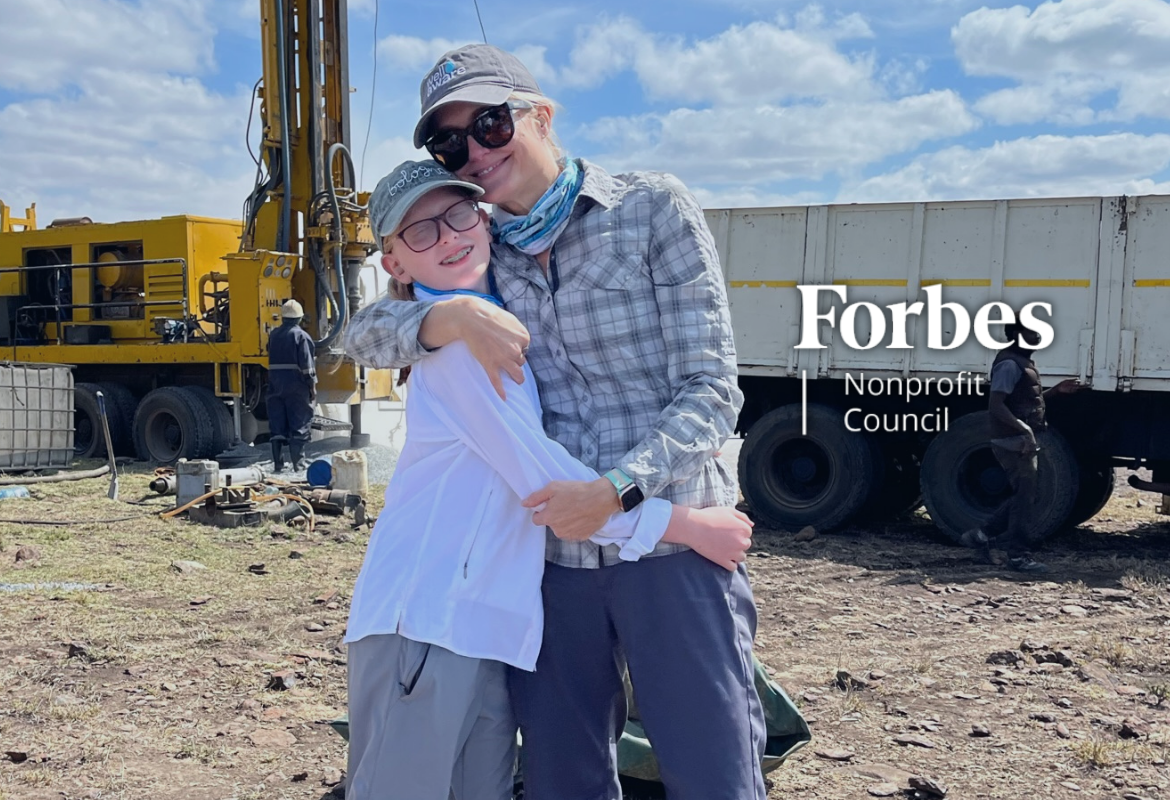
When my daughter, Violet, was two, I got ready for a trip back to Kenya—my first since I’d stopped nursing her. She understood, in the vague way two-year-olds understand anything, that I built water systems for people who didn’t have clean water nearby. What she didn’t understand was why that meant I had to leave without her. So she found her small plastic beach shovel, held it up and made her case: “But Mommy, I have a shovel. I can help you dig.”
I’ve told that story at fundraisers because it’s sweet, and it is. But it’s also the truest thing anyone has ever said to me about what it takes to run a mission-driven organization while raising a kid. She wasn’t wrong that she wanted to help; she was only wrong about what help would look like at two. It took a while, and a lot of both of us, to find out—and it ended up taking a very different shape than either of us expected.
Coming Along
By the time she was three, I had started bringing Violet with me on domestic work trips. She’d hop up on stage with me mid-speech, perfectly at ease with a microphone and a room full of strangers. I couldn’t take a three-year-old to a drill site in rural Kenya, but I could stop leaving her out of everything else—and it turned out there was a lot more “everything else” than I’d assumed. The shovel didn’t go away; it just found smaller jobs to do first.
What They Absorb Long Before They Understand
I was raising Violet as a single mom, and for her first four years we lived with my parents while I built my organization from nothing. There was no version of that season where I could have hidden the work from her, even if I’d wanted to—it was in every room of the house we shared, every trip I packed for and every call I took at the kitchen table.
Kids don’t need a full tutorial to know something matters. They clock the urgency in your voice on a donor call and the excitement after a successful event. Long before Violet could have defined “nonprofit” or “borehole,” she understood—in feelings, not facts—that this work asked something of both of us.
Finding Her Own Way
When Violet was seven, we launched the beta version of an app I helped build to support the long-term sustainability of the water systems we install. I gave her a tablet with the app open, mostly to keep her busy at my desk. A few days later, my team started getting notes—broken links, a mislabeled button, an image that wouldn’t load—in the flat and unbothered language of a seven-year-old who had no idea she was doing user testing. She’d been finding bugs the whole time, just for the fun of poking at something new.
A few days later, my team started getting notes—broken links, a mislabeled button, an image that wouldn’t load—in the flat and unbothered language of a seven-year-old who had no idea she was doing user testing. She’d been finding bugs the whole time, just for the fun of poking at something new.
Three years later, I took her to Kenya for the first time. I expected to manage her the way you manage any kid that age somewhere unfamiliar—keep her close, translate the strange (to her) parts, keep an eye out for boredom, etc. Instead, I watched her fold herself into the communities we work with, in ways I hadn’t coached her on and couldn’t have. Two years after that, we spent an entire summer between Kenya and South Africa, and I wasn’t narrating the journey for her anymore—she was living in it on her own terms.
Somewhere in those years, I understood something had shifted. I wasn’t just handing her a version of the work to prepare her for anything—she was building her own relationship to it, on a timeline that had nothing to do with me.
Not Just Busy Work
At 14, Violet just spent a chunk of her summer break at our kitchen table addressing envelopes and building spreadsheets for my organization—not because I invented a project but because we needed the mailers done and she’s good at it. My own mother did something similar with me: She was an interior designer, and I spent hours as a kid flipping through fabric books and running her errands. I didn’t love it at the time, but I’m grateful for it now.
There’s a difference between work you give a kid to keep their hands busy and work you give them because it really needs to get done, and kids can tell which one they’re doing. The second kind teaches them that their effort has weight in the world before they’re old enough to understand exactly why it matters.
Violet doesn’t yet have the full picture of what a new well means to a community 8,000 miles away, but she knows (with total certainty) that the envelope in her hand is going somewhere it needs to go.
What This Looks Like In Practice
I don’t think the answer is finding your kid a “role” in your organization or manufacturing a project to teach them a lesson … It’s smaller than that. It’s noticing the moments where work and life already overlap—the plane ride, the kitchen table, the FaceTime calls from overseas—and not routing around your kid to protect an imaginary line between the two.
Practically, that meant things like handing Violet something boring but real—mailers, spreadsheets—when we genuinely needed the help instead of inventing something lower-stakes or letting her be bored in a greenroom instead of finding a sitter every time. None of it was designed as a lesson; it just meant she got to grow up knowing what I did, instead of just hearing about it.
None of it was designed as a lesson; it just meant she got to grow up knowing what I did, instead of just hearing about it.
If you lead a mission-driven organization, your kids are probably already closer to the work than you think—through the calls they overhear, the trips they’ve tagged along on and the stress or excitement they pick up on without you narrating it. We don’t need a plan to incorporate them—we need to stop treating their presence near the work as something to manage around.
What I Hope She Carries Forward
I don’t know yet what Violet will ultimately take from all of this into her own life. But I know she never needed the full explanation to understand that the work is real and that she could be a part of it—she just kept finding new ways to prove it, faster than I could keep up with.
Sometimes the shovel is exactly the right instinct … it just takes a while to find its actual shape.